Showing posts with label money. Show all posts

Wednesday, December 20, 2017

Feliz, Eh?

It's almost N-Day. Coming soon. Next Monday, five days from now. Navidad.

Feliz Navidad, y'all. Merry Xmas, that's what I say.

I bought a bunch of gifts, all the same. Little boxes of chocolates, Guylian. Exotic.

Ecuador produces the world's best chocolate, but Belgian chocolate is exotic, so I bought that. Nothing says "thank you so much" like whatever it is that you can't normally get, or don't normally buy, or are unable to afford, or is foreign. Belgian chocolate is all of those.

I've never tasted it, but I've heard that it's good, so that's what I buy.

This chocolate is available in small boxes, four or six pieces per box, and costs $3.50. That's reasonable — I can afford to buy a bunch of those little boxes, and anyone on the receiving end knows that it's not a joke, not cheap, not a toss-off, not an empty gesture, but then again, it isn't wildly extravagant, and there isn't too much of it in one box, just a taste, enough to thrill without satiating.

So I bought around $140-worth this year, a bit less last year, about $250-ish in total for both 2016 and 2017.

The people where I eat lunch each got a little box, and the owner and his wife got a big box ($15). Same at the hotel where I live, though I haven't seen everyone yet. I still have lots of boxes to hand out, but I did get started.

Then I gave another big box to a legless beggar who works a corner about three blocks from here, so he and his family can enjoy all 16 pieces together. I'm glad I got to him before his annual Xmas vacation. He apparently gets by OK from begging but without "gifts" from random people like me, he's got nothing, so I dropped a big one on him.

The "bread lady" got a box. She probably earns minimum wage ($366 a month) at the panaderia, if that, so why not?

And two of the three dwarfs on nearby corners. The third one got away for now. I'll nail him later. I ran out and when I came back to drop a treat into his hands as well, he'd knocked off for lunch, so I strolled past a young female busker and tossed a dollar coin into her hat, followed by a little gift bag containing a box of chocolates. I'm probably the only one who's ever done anything like this. She exploded in smiles.

You know how it's said that it's more blessed to give than to receive? Eff that — it's flat out fun, a real kick in the head, keep the blessings. I don't want any.

I have two friends in the religion biz and they're both dicks. Two former friends, both very bright. Haven't seen much of them them since high school 50 years ago, but I've managed to update myself on their doings and whereabouts every few years. Yep. Religion Biz. Keep it, I don't want any. Nasty and dirty. Ugly.

I turned atheist about age 14, hung onto that for a few years, and eventually grew out of it. Now I'm simply plainly anti-religious. I don't want any of it. I don't care about it. Name your religion and I'm against it, whichever one it is. I'm even more hostile to the business of religion, but some of the ideas behind religion? Sure. One or two. Sign me up. What's right is right. I'm for that. Keep the hatred.

If I can do a little good, I'll do it, and refuse credit. Call me Mr Anonymous. That's fine. Screw the blessings. I don't want blessings, or awards, or recognition or a plaque, signed certificate, or my name in the news.

But fun, sure. I like random unexpected fun, especially when I can cause other people to experience it.

Giving stuff away is cool. I have more money than I need and since I'm going to die soon, if I don't spend it it will do no good at all. A few bucks here and there, scattered irresponsibly via walk-by charity, will make a few people feel good, and that makes me feel the same. Feeling good is good.

I wish I was this nice every day.

Sunday, April 24, 2016

Cuenca Is

Cuenca is like a long exploration of Grandma's enormous old attic. To me. But what do I know?

Not that much, as world travelers go.

I've been to Canada a couple of times, along the southern border (or along the U.S.'s northern border, if you will). I've been to Bismarck, North Dakota, to Minneapolis, to Denver, and Sante Fe and Tucson, and I lived in Seattle for a while. Almost two years. Just two blocks north of Seattle's city limits. That qualifies. And Bellingham, Port Angeles, and Olympia.

So I don't get around. Not that much, but I've seen a bit. I've seen more, I think, than my former friends and acquaintances who never left Bismarck, who never left permanently anyway, or who left but didn't make it outside of North Dakota. For long.

It's odd what a backwater will do for you. A backwater place, a quiet corner of the world, like Bismarck, like North Dakota. In a way — odd to me. I had friends there who moved in from Chicago, for work, and became permanently affixed. They went native.

Maybe it was already in them, or maybe the place changed them. I don't know now and I never will. I've lost them. We have no more contact, not for 11 years, since they decided they no longer wanted to have anything to do with me.

In a sense that's good, though I'm still a dick. I'm not easy around people, even people I've had long-standing relationships with. Friendships, working relationships, relationships with relatives — all the usual. I'm still awkward, and sometimes I don't meet expectations, or I say the wrong things, or miss the cues, and come off as a dick. So I'm a dick. That's who I am. Stand back then.

But for a while, while I still had friends, I noticed something, especially with Nick and Patricia, my friends from Chicago. Though I never could stand Patricia. She came with Nick. Part of the deal, so you had to put up with her. But back to our story.

I returned to Bismarck after being away six years, and went to visit Nick. At that time I was still welcome in his home. I went there, was welcomed in, and sat down. Nick and I began talking. We picked up our conversation from six years earlier, as though we'd last seen each other just a week before, instead. The place is like that. Friendships last forever. People don't change much. They don't grow either.

That's one thing I noticed while visiting Nick and Patricia, and Norman, my former boss and co-worker, and John, former friend and former co-worker. And my parents. And others. I had changed and they hadn't. I had changed a lot and they had only gotten older, and were still talking and complaining about the same things as always. In 1993, Norman and John were still complaining about the same problems at work as when I'd left that job in 1975, and John had not worked there since 1974.

Cuenca is like that too.

I can feel it. I am not an expert, and nearly deaf, so I can't converse to any extent. But I've seen some evidence.

Two years ago my Spanish teacher chided me when I related a story of trying to enter a department store by walking in through the checkout aisle (you know — the passage between two cashiers — in the U.S. you go through backward when it's handy). "What if everyone did that?" she said, annoyed at my gringo ways.

I had been stopped halfway through by the cashier and made to go back "out" where I had to loop way around and enter the store's inner sanctum via the official entrada. Even though nothing was going on — it was slow that day. There were no customers trying to pay for things. The coast was clear. Which is why I decided to do it. But I had to go back and enter the right way. Because.

The whole city is like that. It is full of old buildings and old ways. The old is piled on top of the old, with some new sprinkled here and there. Both customs and things. Sprinkled. It is charming in a maddening way. I notice things nearly every day.

At one place I eat, when locals enter, they leave the door open. A staff member has to go over and close the door. I eat there three times a week. This happens four or six or eight times during each half-hour period I'm there eating. Every single day.

It's how things are done. They just go over and manually close the door again and again. They've always done it that way. It doesn't look like they'll change. Even with my help.

I tried.

I bought a pair of cheap door closers. Really cheap. Five bucks each. Simple springs that you can affix to a door at a hinge. I brought these along and when I had a chance to bring up the idea, I gave them to the restaurant's owner. He was happy to get them. This was eight months ago. He still hasn't used them. He and his staff prefer to stop what they're doing, walk over to the door, grab it, and close it. And to repeat this all afternoon, six days a week. Rather than to use what I donated, or find something similar.

I knew a cat once too, in Bellingham. It was the neighbor's cat but we were buddies, and the cat came to visit me every morning, climbing up the half-ladder, half-stairway fire escape below the back window. It had learned to do this on its own to get to the roof of a shed where it would nap. It continued this way to visit me, first climbing up as high as the roof of the shed, hopping off the step to the shed's roof, then immediately hopping from the shed roof back onto the stair it had just left, and then climbing up the rest of the way to my window. It worked.

But there was no reason the cat could not have climbed up the whole distance to my window without making a stop on the shed roof. Except that the first time the cat had gone up the ladder it went to the shed roof, so that was how it was done. The trip to my window got added later, and the roof detour remained a part of the routine, even though there was no point in it.

Got it?

Living here is like that.

"If it ain't broke, don't fix it" is probably the maxim I hate the most. Or it's at least close. "We've always done it that way" is another great one, and is interchangeable. I think I hate that version even more. It's rolling stupidity. My home town is full of it. My relatives were full of it. Everyone is full of it. People do what they've always done, because. Just because, you know?

Don't question. Don't cause trouble. Don't make us think. Why do you always have to make trouble?

Because I'm a dick. It's what I do. Though I'm not complaining about Cuenca. I like it here.

Because I don't have to be a part of it. I'm a perpetual passer-by. Because I can be. Because I'm rich.

I'm philosophically opposed to being rich, but I am, here. My income, relatively small by U.S. standards, puts me roughly in the top 10% in Ecuador, though there are many locals who have far more income than I do, but still I'm hanging with them, statistically speaking.

And since I'm rich, because I'm rich, I don't have to belong, so I don't have to play by the accepted rules, so I can be an outsider as long as I want, though I think I can understand some of how this all works. It works because people don't want to lose what they have. They're poor and isolated. The poor and the isolated are conservative and seldom think new thoughts.

I learned this from North Dakota.

Taking a chance is taking a chance. Taking a chance is dangerous. You don't want to do that. There is no reason to do that, if what you have gets you by. If what you have gets you by, then fine. You do that. But you don't get creative and risk it. You don't dare. You stay the course, conform, fit in, do it the way it's always been done, and then your children take over, and then your grandchildren, and on and on.

And Ecuador is not North Dakota. Which is why I'm here. Ecuador is much more of what I liked best and liked least about North Dakota. My friend John used to say (when he was still my friend and when we talked) that North Dakota was 20 years behind the times, and that was what he liked best about it. Ecuador, until the last half-century or so, was several hundred years behind the times, and I'm right in the middle of the slow region. Inland, in the mountains.

Along the coast things were never so slow, never so isolated. There was contact with the outer world. Ideas flowed. Cultures mixed. Change was a constant. Inland, no. Things stayed the same for half a millennium. Then they changed. But slowly.

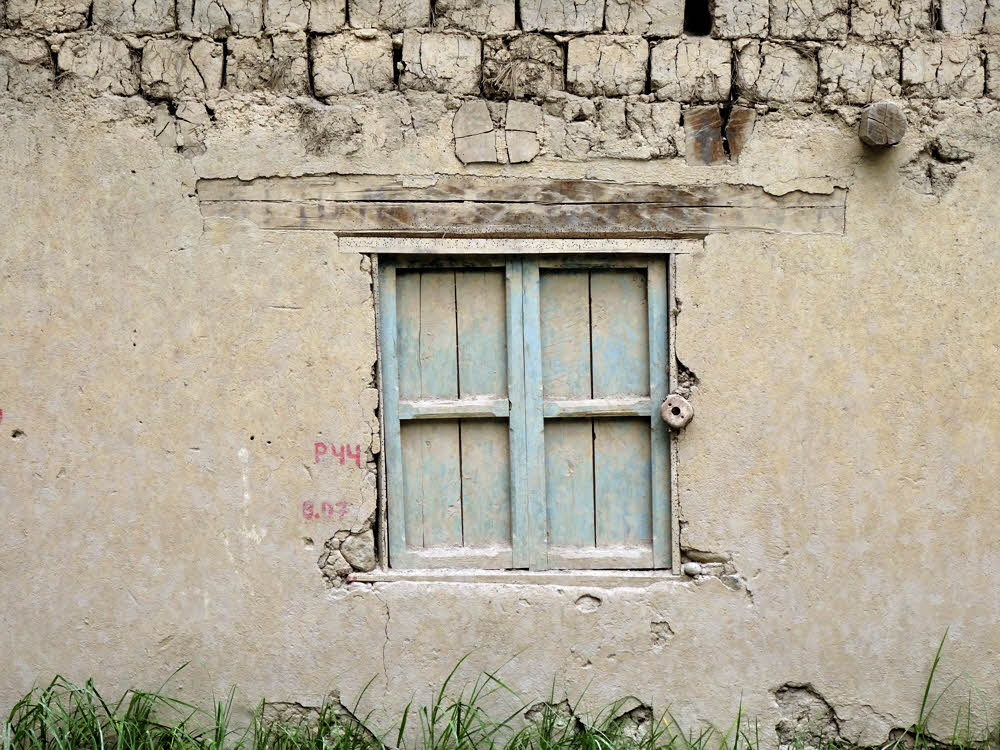
OK by me. I like the climate. I wander around in the balmy bug-free weather at 8000 feet enjoying the sights. I like the peeled paint and cracked adobe walls, the broken pavement, the sounds. It's fine. Even the dust and the dogs. It's interesting, especially so since I don't have to be part of it. There is always something going on up and down the pedestrian-choked streets. I can use my imagination, just like I did exploring my grandmother's basement and my grandfather's garage. Looking at all the odd stuff and trying to imagine how people could live that way.

Which is what I'm doing here, in between trips out to lunch, or naps. So who am I to complain?
Sunday, March 20, 2016

Guardians Of Darkness

The guys hanging out inside the planetarium. Them. They're guards.

I haven't been to the planetarium in Cuenca, but I'm familiar with the idea. Planetariums are dark inside. That's the point, confirmed by my one sighting, in Moorhead, Minnesota around 1971, when I took a sort of astronomy for noodle-heads class.

Planetariums are dark so you can see better. Which I don't have to explain because even if you think about it and come to the rational, reasonable, sensible conclusion, you know better. You know that inside a planetarium you don't want to see everything. In fact, you don't want to see much — just a few tiny points of light.

Which means that the darkness helps you to see better.

Another characteristic of planetariums is that they're empty. They have seats below and a dome above. And air. Most of the place is air. That's about it — like a movie theater. The place is about ideas and not things, and is full of dark air.

So it's funny (to me, still) to walk past the Cuenca planetarium and see one or two or three guards just outside it, or just inside it — What?. I should know by now. Guards. They're everywhere.

I did, during a previous incarnation here (at least a couple of years ago now), finally realize that guards, even armed guards, who are everywhere here, aren't so much armed guards. They are receptionists. And as with receptionists everywhere, their primary role is to maintain order. Their secondary role is to provide information. Their tertiary role is to control access to whatever inner sanctum that particular place has. And in Cuenca, a receptionist's ultimate role, the one of last resort, is to shoot you if you misbehave.

But only if you're exceptionally naughty, you see. Not usually.

Usually you see guards standing around hour after hour, five or six days a week depending on the hours of the business, or seven days a week even if the place is closed but important, like Banco del Ecuador down the street. You don't want anyone kicking their way inside that place and making a mess, so you leave at least one guard in place after the lights go off and the doors go into lockdown.

Which still, despite my getting used to a lot of things, or at least at least my witnessing of a lot of things, many of which I remain completely and eternally clueless about, leaves some room for wonder about the guards at the planetarium, because For why?.

I don't know why.

If I wasn't functionally deaf (meaning that I can hear but not too good no more) and thereby incapable of becoming functional in Spanish, I could ask. Most receptionist/guards seem happy to talk and why wouldn't they? They got nothing else to do all day, but I can't ask, you see, so I'm going to guess.

My guess is that to get into the planetarium (legally) one has to buy a ticket, pay a fee, pony up some coin, so. So this means that somewhere in there they have a box full of money. A box with a bunch of money in it. Some cash. At least a little. Possibly. Though who can say for sure? It's a guess.

Therefore the guards. In case someone might think that there is enough money in there to make robbery seem like a reasonable thing, even if there might be only $25 in quarters and dimes in there. This isn't a rich place, and people don't walk around throwing $50 bills in every possible direction — it's more like a dollar coin, a quarter or two, and a handful of pennies. If you can find pennies, but then again, if you do manage to find pennies you get really cautious about spending them, so maybe not. But maybe.

Again, I'm guessing. It's called for in this situation, so let's keep running with it and see what happens next.

So in essence, the guards at the planetarium are there protecting an idea. A potential. Putting up a barrier for anyone who gets his own and opposing idea. It's an intellectual standoff, a practical application of performance art: We are here with guns and clubs and uniforms and a big room full of darkness and you are out there, misguided, misinformed, with no income but not lacking in ambition and an urge to try something desperate on spec. And we say No — probably not a good idea there — don't try that, OK? Please? Just keep moving, go somewhere else if you would.

Maybe that's it. My best guess for now. Go figure.

Monday, February 17, 2014

MaxiFutz

What's in your pocket? Can I have it?

It happened again yesterday.

I should have known. I should have been prepared. I should have expected it.

Notice those words? should and have. I should have. But why?

Life here is odd some ways. You have to be on guard. You have to remember to be on guard. Even if you know what's coming toward you, and from which direction.

I had to know that this one was coming for me. I should have known. I did know, because it's been happening every couple of days for a long time now. I've been through it before, this nonsense. Just not so totally absurdly.

Ecuador uses U.S. currency. It has since 2000, when the previous currency, the sucre, crashed to a value of absolute zero, plus or minus nothing. And the fun part, if you like crap, is that now, in 2014, there is still dust in the air.

What I mean is that a person has to be careful paying for which with what, and then expecting a reasonable thing to happen.

A twenty is the top end. You could squeak some deals with stacks of Benjamins, but not all. Some. Even then you'd get the big hairy eye. But some things you could do. Like paying your rent. Maybe.

Paper money is suspect. Always. The bigger the bill, the greater the bogus buck passing profit, so people check every bill. They have to. Twenties work. Twenties are acceptable and available, and I use them. Bigger stuff? No idea where to even get it.

I paid a $650 fee with 32 twenties and two fives, not long ago. Business as usual. You carry a wad in your pocket. Then you spend time counting it out, and hand it over. And then the other party counts, and then you're done. Eventually. Life in paradise, OK?

What I can't get over is the constant change crisis. Which is the other problem. The real problem.

For some reason, coins are an endangered species.

I understand a one-person shop not having bags of coins to cover every occasion. Reasonable.

I don't understand a multi-million-dollar businesses with its pants down, every day. Caught out. Permanently in drydock. Like SuperNutzi, the maximum grocery chain.

I believe I can still hear them sighing over my last visit. They pain me. I pain them. Because they have such a hard time getting the change they need from me. Because I expect to get change from them.

True, it could be that they do not know about banks, and how to use banks, and how to plan ahead, and I ought to be more charitable, perhaps, more cooperative. And, stupid me, I'm not.

Take yesterday — please.

I bought cheese and cookies. $6.31. I handed over $6.35.

Boom. Cashier Fuddle Event. Lights flash. Recurring Four-Cent-Problem eruption. Cashier requires pennies. From me. What to do? Emergency. Situation critical.

Situation critical because this giant company does not know how to have change on hand. Customers coming to buy is a big surprise. It throws them off every time. Every time they open the doors for business. Every time they open the doors for business, and someone comes in and makes a purchase, and needs change. Ow.

I always catch SuperNutzi flat-footed. Always. Over pennies and nickels and dimes. Even though Ecuador mints its own. I don't think they know this either.

Pisser.