Showing posts with label government. Show all posts

Wednesday, December 21, 2016

Taking Steps

What's a prisoner to do?

Pace.

Luckily, my cell is large. I can take big steps.

I have room to rattle around aimlessly between the walls. I can go out the door, hit the street, and as long as I don't get lost, I'm OK. But this isn't really hiking, let alone backpacking, which I miss.

I spent most of the summer back in the U.S., sort of randomly backpacking around Washington State, living in a car I bought in July and sold in September, parked in nooks I found in the woods or in state parks when not on the trail. It was good enough. My time was limited and I didn't have any real plans other than to be there and enjoy summer.

My time was limited because I'm in the middle of a sort of probationary period defined by the Ecuadorian government. I'm kind of a refugee, a refugee from winter, so I'm now an Ecuadorian resident. An official, legal, recognized Ecuadorian resident. For the third time. Yeah, right — did this before. Blew it up twice. On my third round now. They let you do that.

The deal is, if you meet the requirements, which in my case is being able to prove that I have a permanent lifetime income of at least $800 a month, and no criminal history and so on, then it's basically a matter of filling out the paperwork and waiting a couple of months, and then you're in. You can stay. Forever. You can even vote. Such a deal.

And the climate here is crazy good.

Typical temperatures:

  • Overnight low: 50° F (10° C)
  • Daytime high: 68° F (20° C)

Wind: not bad, usually light. Sunshine: YES! Rain: Now and then, around 35 inches per year, or 889 mm, but things usually dry up shortly after a brief shower.

I'm also a former burrowing mammal from North Dakota (Land of the Frozen Dead), who moved to western Washington in 1979 and was amazed that winter never came that year. Things got darker and cooler and wetter and then started getting brighter and warmer and dryer. Summer turned to fall, which turned to spring, and then summer again. Wow. No winter, even though I grew my usual fur in anticipation, out of lifelong habit.

It was like that for a long time. A real treat for someone who grew up where the weather could kill you dead any time of the year, but especially in winter. Winter is an OK season too, but not eight months of it. That's nuts.

Well, eight months of cold or at least cool weather. In North Dakota my favorite month was October, when everything got dry and crispy and clean — no bugs, no snakes, no poison ivy, no humidity, no heat, no storms. Just progressively colder, and mostly calm-ish. Cool trending toward frosty trending toward frozen.

After that was November, which was more of the same, but a little closer to the killing edge, and then December and the holiday stuff, and after that January. I'm not sure what January is good for, but it was right in there like clockwork.

And then after January things got cold. Seriously, truly, uncompromisingly.

February was usually the coldest month in North Dakota. Brighter but colder. It's a characteristic of continental climates. There's a lag. It's like the earth way out there doesn't quite know what's going on, a communications lag or something, so the earth is always a couple of months behind, and keeps getting colder even after the sun begins getting hotter again. It's a thing. You have to deal with it. Or you die.

The last winter I lived in North Dakota, I worked outside. Delivering lumber and other building supplies by truck, around town. Just local driving. I walked to work. The coldest day was in February. Minus 35° F in the morning, minus 7 for the day's high (-37° and -22° C, respectively). Chilly. Not windy though. When it's that cold, at least the wind gives up and stays home in bed, so overall, not so bad. But North Dakota winters go on for friggin ever. That's the deal. You get tired of it.

And then you get older and it's not fun any more. So I left.

And after a few decades in western Washington I got tired of the gray winter skies. True, you can get by wearing only a windbreaker for most of most every winter (and by carrying an umbrella), but you start to go crazy too. In western Washington, it's the same kind of deal as in North Dakota, but with gray skies and drizzle instead of world-killing cold, world-killing cold and wind.

In western Washington, endless humidity and drippy skies drive you nuts by around January 4th, but things don't clear up until mid-July. Yeah, right. July 12th or 13th. I forget which. One day or the other. Like someone flips a switch. After that it's summer. Summer, and it all seems worth it once again. Summer's a killer in western Washington. In a good way. Best summers ever, anywhere. Usually lasting until the third week of October. After that, you start to see some rain again. Then more rain. Then November. November is the stormiest month, especially around Thanksgiving, but it sort of feels cozy. You get to stay indoors and eat stuff and watch the world blow around outside and the ground is suddenly covered in colorful leaves.

Which begin rotting pretty quickly. So they liquefy and then there is more rain and every day is a gray day, and later on sometime there will be a nice sunny day and you feel good again and then it rains for another two weeks after that, and so on. Yeah, right.

I spent several years living in Bellingham. Since I was busy starting over, learning math and physics and such I didn't pay much attention to the weather until I read the newspaper headline one day: Sun Visible for First Time in 60 Days (paraphrasing here, but a true story — from about 1982). It was actually front-page news.

It does make you crazy after a while, so when I got old enough I figured Hey, enough already, and moved to Ecuador.

And then got bored, and moved back, and then got bored with that and moved back to Ecuador and got residency a second time. And then got bored, and moved back to the U.S. and got bored with sitting around all winter (but summer was nice), and got a severe case of the galloping dreads looking at my second winter back there, and moved back to Ecuador and got residency an effing third time, and now here I am again. (Slow learner, wot? Cost me a bunch too, but money's free these days — it just rolls into my bank account toward the end of every month, so it's only numbers. I don't really have enough to live in the U.S. any more, but here I'm actually rich-ish. Can't complain. I'm free to do stupid things now and don't have to get up and go to work and be around morons any more.)

Oh hang on — I can complain.
First, I'm a dick. But then, someone has to be, so deal with it. I don't care. (Yes I do, but I'm trying not to whine.)

Second, there's this problem with Ecuadorian law. See, if you get residency, you have this probationary sort of period that goes on for two years. For those first two years you can't be out of the country for more than 90 days each year, or you lose your residency, and I've done that already, so this time I'm biting the bullet and living with it.

I was gone what was it, around 82 days in 2016. My anniversary date was December 7, so I have another 251 days to go until I'm totally permanent. After that I can be out of the country for 18 months at a time. That would work. Meanwhile, I can be gone up to 90 days again between now and next December 7. Happy Pearl Harbor Day, me.

After I see another year go by I can spend eight or nine months backpacking while maybe living in a van, and three or four months here, enjoying not-winter. (By the way, the UV index for today is 10. That means if you spend more than 12 seconds out in the sun your skin starts smoking and bubbling. After a minute or so your skin is fully cooked and starts to slide off. Been there, done that too. A week or two back the UV index hit 13, which will take paint off a cattle truck. But them's the benefits of living at 8000 feet or 2438400 mm. And no bugs neither.) For the rest of this week, the UV index will be just extreme. I'll write you when it's over.

But hey I'm bored again, even with all this bubbling, smoking skin going on.

The big humpy part of my day, the pinnacle, the acme, peak, summit, crest, crown, tiptop, the height, the supreme pointy part, is lunch. I do lunch now. That's my day, most of it.

After lunch, it's downhill. Not a whole lot going on, unless I go for a walk. So I walk too.

But I'm in a city. This isn't like hiking, let alone backpacking.

There are places I don't want to go, and places I can't go, and other places I shouldn't go, and then there's night. Days are relatively short here, year-round, since we're 2.54 degrees south of the equator. Sunrise at 6 a.m., sunset at 6 p.m., and then it's dark, and anyone with any sense doesn't go walking around after dark, and if you do, you quickly find out why not, so it's lunch and daytime tramping for me. For now. Though I'm still bored. And haven't figured out where or when I'll spend my 90 days of freedom during the next 12 months.

So I'm back where I started: What's a prisoner to do? Pace. Luckily, my cell is big.

And it has high walls. Maybe I can't quite escape, but I can climb up the walls. That's what I do sometimes.

"Cuenca" means "basin". The city is in a football-shaped valley. Officially, it's "Santa Ana de los cuatro ríos de Cuenca", Saint Ann of the four rivers of the basin, whatever that's about. Basin, watershed, catchment area, socket, bowl, hollow — take your pick. Valley. The city is in the bottom of a bowl-shaped valley.

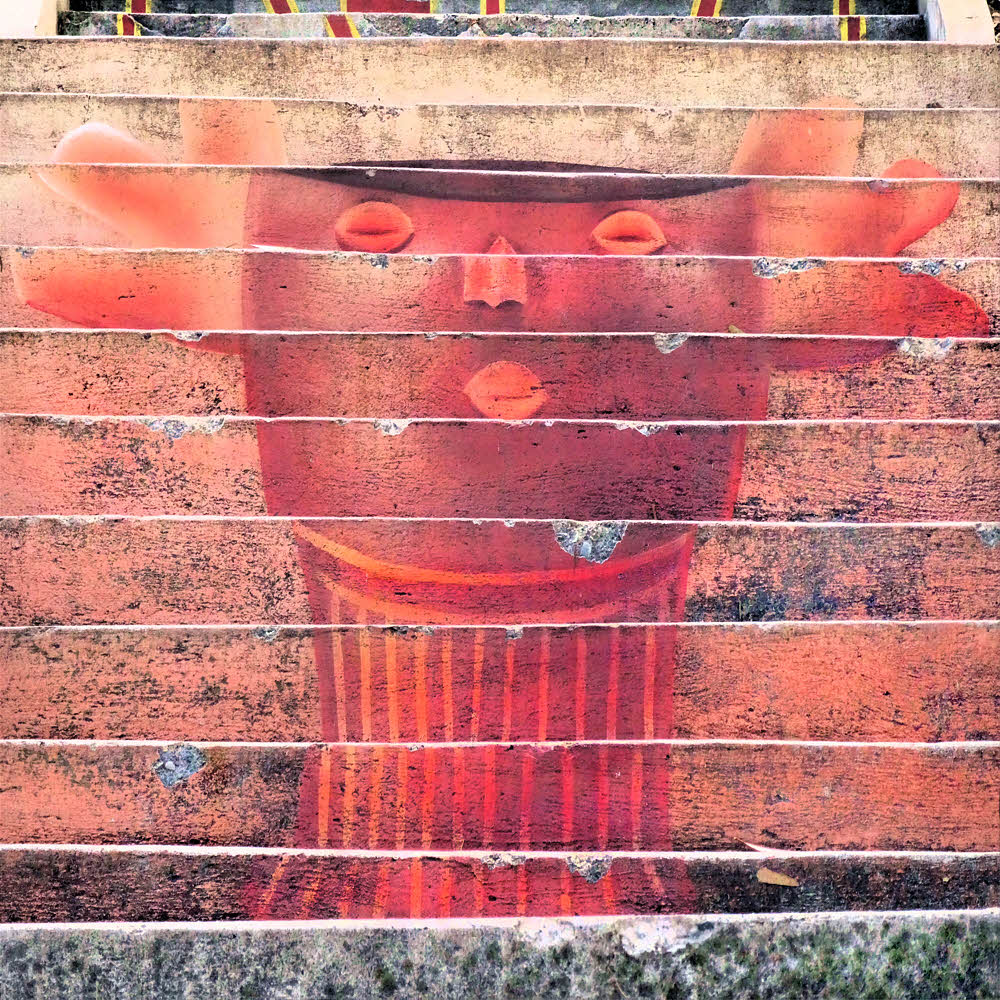
To the north, the nearer valley wall. It's a short steep walk up to an overlook. Then it's a short steep walk back down. A decent workout that takes around 45 minutes if a person meanders around somewhat. Not too bad, but not a hike. But there are stairs. I like the stairs.

You can walk along streets and sort of make it an up-the-ramp walk or go the other way and end the ascent with about a hundred feet of stone steps (30m). Well, maybe 70 feet, but it looks intimidating from the bottom. Maybe only 50 vertical feet. Who am I, some kind of damn expert or something? It's a workout. Which is what I need. I go up and then come back down, huffing and puffing and snorting and farting with the effort.

But that's the toy workout. Nearby, accessible, quick, easy. Something I do when it's late and I have to do something but can't do the real thing.

The other one is the real thing: The Turi Trudge. This one can kill you. I love it.

Instead of going north, go south. See, the deal is, there is another valley wall over there. Conveniently, valleys have two walls. This second one is farther off and it's higher, and has extra special benefits.

Benefit Number One is, you get to tromp across the full width of the city. (Well, I live kinda to the north a bit, on the edge of what they call the "Historic Center", or el centro, so my walk covers most of the city's width.)

Benefit Number Two is, you get to work on your traffic-dodging skills. Which you have to do any time you step out of your door, anyhow, but let's gloss over that, 'K? And pretend that this here mess-a-words is, like, you know, imposing and important stuff. And that this is extra-special traffic-dodging.

So it's about a two-mile walk to Turi from where I live, starting with the across-town part and vehicle-avoidance, which includes running for your life and swearing, and all kinds of other fun things. But then you get there, to the south side of the city. And then the fun starts, because things suddenly get vertical.

Benefit Number Three is, stairs. Lotsa stairs. Stairs going up. To Turi. Turi is a sort of little town on the edge of town, and there's a church up there. (There's a church everywhere here — can't swing a dead cat without hitting several of them, even with your eyes closed on a cloudy day.)

Turi must be 500 feet up from the last road crossing, let alone the main part of Cuenca. Even in metric that begins to sound a bit imposing: 150 meters or thereabouts (152, eh? In case you're literal).

Cuenca from Turi.

OK, so first you walk the full length of Avenida Solana across town, and if you've managed to dodge all the deathtrap intersections, you get past the last traffic circle and there you are at Bocatti Tres Puentes. ("Hacemos lo que mas te gusta". OK, whatever.) In case you're in a deli mood and want to stop there and buy raw meat and just go home again. Again, whatever, all right? Get over it.

Which you do (get over it) by veering left and crossing the street. If possible. Because traffic, etc.

And then you take a right down the next street, and you begin ascending just about there. No fooling. By now the time for fooling is over. It's about to get serious.

And if you didn't think I meant it about traffic, well a year ago a bus ran into my hotel. Crash. Just like that. Slammed right into the corner of the building, maybe because it thought the hotel was issuing a challenge by not running for its life, or simply out of cussedness. You never know around here. Bang. Lucky for me I'm in an apartment in a separate building out back, so the first I new about all this was when I went out to to go lunch. (See the importance of lunch now? It teaches you things, like WTF is going on out here? I head out for lunch on a normal, quiet Sunday and here's this damn bus crossways in the intersection with its teeth sunk into the hotel and police all over, and about a million people all standing around waiting to see what will happen next, and all kinds of whatnot and you never know.)

So if you live long enough to make it that far, you go about a block more and there's a street going off to the right but you make a tiny jog left and enter what looks like a private driveway but isn't, and after another block the street ends and the stairs begin, but these are just the pretend stairs. They're there to fool you. To bluff you into going the other way, which will take you to a dirt road leading around the shoulder of the mountain and into some sketchy semi-farmland territory where it would be all too likely to find yourself facing a pack of angry dogs who need some tooth exercise. So guess who went that way once and lived to tell about it? Luckily the dogs were on vacation or something that time, but I'm not pushing my luck by going that way again.

Anyhow, the stairs.

Much nicer.

Houses on either side, with their gates and walls topped by barbed wire, but you mind your own business and stick to the stairs and that's work enough. Don't mess with them people and their barb wire, prolly they won't mess with you.

Just start climbing. Stop to catch your breath, turn around, and there's the city behind you, getting lower as you get higher, but that's not why you're here, so you get back to the stairs and climb some more, and after you're about ready to die you keep climbing and then you're over the hump and descend to the autopisto.

And it is a pisser. Four lanes, divided, death trap. But that's part of the fun, innit? Vehicles coming at you faster than light, with evil glints in their bumpers. You cross if you can.

After that, it's another block or so, and then another, smaller road to cross. Also a death trap, but what isn't around here?

And then...
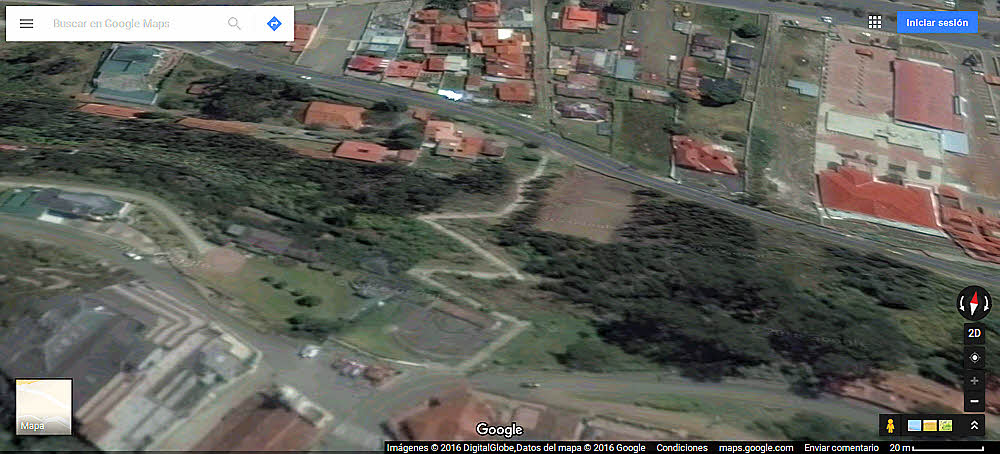
A crude view of the Turi climb. (Can't find nothin better.) About a million times tougher than it looks.

The Stairs. The Real Climb. Death On A Stick. Pant-O-Rama. The Ascent Of Endless Pain. Around 500 feet up and no one to get 'er did but you and you feets. You there, with the legs and the attitude: Take this, Smartass. Just try.

So you do.

And after you've been there a few times (up once, down once), you think about doing two laps. Up once, down once, up again, down again or die puking. And then, later, you wonder about doing three laps. Hey, since you're already there...

You know. Life — something you do to kill time while waiting to die. Relieves parts of the boredom and whatnot and it's exercise.

So if I can't get out and do real hikes, or go backpacking right now, at least I've got this.

OK, sure, I should have friends and do stuff but I'm a dick, remember? So I don't get out much. I'm awkward, like a turd at a pizza party. No good at hanging out with other people and enjoying life. Haven't found them other people that gotta be here somewheres that I can do stuff with. I do know a couple of cats around here, and they're nice, but they've been avoiding me lately too, and one bites, but without them I'd have no friends at all, so I just suck it up and carry bandages when I go a-visiting.

I'm mostly deaf too. Did I mention that? On top of the rest I'm mostly deaf now too.

Yeah, right. More fun stuff. Mister Dick-O-Rama.

Woke up May 15, 2012 and my left ear no longer worked. I happens. Leaving me with my right ear, which is only slightly more useful for hearing with than a rusty shoehorn. So I'll never be any good at Spanish, or even at learning Spanish, which makes me even more of a dick whenever anyone on the street stops me and asks for directions, or just the checker at Coral or SuperMaxi trying to be helpful, and saying something, or asking me something, and I'm standing there like an ugly (though tiny) moose, with my tongue hanging out, all puzzled-looking and dopey. (Tiny — at least I'm not ugly and huge. Then again, neither is a tapeworm and you know how much fun they are.) And with moose, you know, you never know, even with the small ones, so I scare people once they catch on that I'm not actually a reasonably predictable human thing. So life in paradise. Ain't all you'd expect sometimes. For me nor them.

Somebody's working on setting up a Hash House Harriers chapter here, and that might help. "Drinkers with a running problem," they call themselves. Active people. I can't run (back problems) but I can walk like crazy, so maybe I could fake it. We'll see. No matter how fast they try to run away, there I'll be, coming up the backstretch. There's always hope, even for me. Woot!

Does anybody say Woot! any more?

Maybe just me.

Later then, if you haven't had enough yet. Maybe see you on the steps.

(Anything here you don't understand besides me, it's on Wikipedia.)

P.S.: Hey! Wanna go hiking sometime? Just kidding. Ha! Bite me.

Bye.

Sunday, March 6, 2016

US Ambassador Locates Ecuador

For U.S. Ambassador to Ecuador Watt C. Muffly, it's all about relationships and opportunity.

Apparently. That's what he says.

The new U.S. Ambassador to Ecuador speaks softly and has an easy smile that generally makes him immediately approachable, but today it's somewhat different. He's still speaking softly but (for a while) his tone was uncertain, evidencing perhaps a slight amount of trepidation. Perhaps confusion. Disorientation. He was not exactly sure where he was, exactly. For a while.

True, the Ambassador has heard of Ecuador, a smallish country sitting on the left shoulder of South America, and did know that he had been posted there, and was sure that his plane had been pointed in that direction. But he wasn't sure that he had actually arrived.

The map, his map, didn't seem to match up with anything he saw, which was initially somewhat confusing.

But this was all straightened out when he turned the map over, and then things got even better when he put north back where it belonged — on top. Everyone sighed. Some with relief.

According to those who know him, the Ambassador is is the kind of man you would invite to dinner at your house, just because you know he would be a good addition to any mix of company. Which may be why he got the job. Or maybe his map-reading skills indicated that a posting to France could be problematic for various reasons.

Anyway, he's here (or there, depending on where you're standing at the moment), and things are looking better now.

Last week the Ambassador was in Cuenca, a city known as a U.N. World Heritage site, due to its funky old buildings, and also known as possibly the cleanest city in all of Latin America, and the one with the best drinking water. All good things.

Once in Cuenca, the Ambassador introduced himself to local authorities, expats, and members of the news media while becoming more familiar with the city. By stepping in a pile of dog excrement. Which happens, even in Cuenca, because clean is a relative ranking, compared to other places, which can be much worse.

But it happens. You have to get past it. Which he seemed to do by way of a short hop following a brief utterance. Before wiping his shoes on the mayor's lawn.

Coincidentally, and possibly felicitously, Cuenca Mayor Marcelo Cabrera was traveling, out of town at the time, so no one other than second-rank flunkies saw any of this, and an introduction to the mayor will have to wait for another time.

This is also good, most likely.

Other than that event, as noted, the Ambassador said that he has had a smooth start in building those relationships that he views as critical to his work. The prefect and the governor presented me with no complaints, he said, smiling with a satisfaction that presumably represents his government's views about right and wrong.

I really tried to get them to tell me if anything was not going well, and they said 'no, the American expats who have settled here are all great — they seem to do nothing but eat, and deposit gobs of money from their retirement checks, right here in and around our city streets, and since they had to leave their guns at home, we mostly don't fear them so much any more'. And that's wonderful to hear — just the way we like it, the Ambassador concluded, pretty much amicably.

In an expat media interview Saturday morning, Ambassador Muffly continued to express his approval, suggesting only that U.S. citizens could advance the work of the U.S. State Department a bit by integrating themselves even more into the city and its efforts at improving education, health, the stray dog situation, whatever, like helping to fix up some of these old buildings, maybe getting a Walmart or two out there — that sort of thing. Couldn't hurt, as long as we bring here only the best that American culture has to offer.

Also, of course, whenever anyone coming to a new country experiences things that are a bit different or that we don't like, the Ambassador said, continuing to wipe his shoe after moving to a fresh patch of lawn.

I would hope that expat media would not use its platform for complaining about Ecuador. Saying 'why don't they have this here' or 'why don't they do that' makes our job as relationship builders more difficult, he said, seeming to be only slightly distracted by this time.

And now, a full two weeks after arriving, how does Muffly feel about his new posting to Ecuador?

I'm excited. Terrifically excited. Really. I am. Just going on a brief walk around Quito (where the Ambassador resides) I found two shoe shops that carry footwear in my size. I can't wait to get back there and do some serious buying, he said, shaking his left foot as he spoke, perhaps unconsciously. I'm definitely not looking backward, or downward, only forward toward a successful resolution of all issues, he said, continuing to smile weakly, though diplomatically.

Which might be why he got the job.

Monday, April 7, 2014

Passing My First Bus Exam

Caught between wheel and fender.

A bus pass debit card cost me $1.70. To buy it, I had to visit a guarded facility. The facility is a government office, hence the guard. Steve was showing me around. He's good at that. It seems to be his job now that he's retired and living here instead of there.

He learns, he makes friends, and then helps those friends to learn what he knows, about living here, getting around, coping, finding things.

Steve spoke to the guard, who let us into the compound. Didn't I mention that? Oh. There was both a guard and a gate. The gate is locked, the guard is armed, and you have to say Please.

Steve speaks Spanish well enough to communicate. This is true. I know because the guard opened the gate and allowed us in, and he was friendly about it. People like Steve. Steve is friendly. He gets things done. And likely there are very few attacks on government facilities by retired gringos in this neighborhood, so the guard felt comfy all-around.

Inside? Things were better than you might expect. This is an old city, in a country not known for its excess wealth, so you get, on average, an improvised, patched-up experience. But this office could have been one in a renovated historic building on any of a thousand well-off college campuses. The building? Not new. The office? Yes — clean, up to date, orderly, and well lit. The staff were polite and efficient. I was done in a few minutes.

First, one of the clerks took my information, made a copy of my passport, and generated me my very own plastic ID card. I had them put $5 on it. All my personal info, and my balance are encoded in a magnetic strip. At 25 cents per ride, my $5 entitles me to 20 trips, and now that the system has transfer stations, one ride can take a person here, there, and everywhere at almost no cost.

They told me to come back after I turn 65. That's when the cost of riding is cut in half, and I will also get a photo for my pass. So, twelve-and-a-half cents per ride. Which leaves me wondering how that gets paid in cash if a person doesn't have a card, or forgets it at home.

It is completely possible that I will never know. I have a collection of things like that. Right now, and for at least a while, this question has joined the crowd inside that darkness.

After that short visit, we went riding. The buses have unwritten rules, but they are important.

Rule Number One — Be nimble, and quick, Jack. The bus is reluctant to stop and impatient to continue. If you aren't ready for it, and don't grab it, you don't ride it.

Rule Number Two — Hang on. The bus accelerates from its millisecond pause like a bull with fire on its ass. Don't have a solid grip on something? You become the entertainment.

Rule Number Three — Move back. Way back, if you intend to get off somewhere. Buses swallow passengers up front and emit them out back. Easy to remember, but problematic when a dense crowd blocks the route (all day, every day). Too bad about that missed stop. No one cares.

Rule Number Four — Signal your stop. You do this by pushing a button. The button is near the back door. If you can't get to it, then your ride goes long.

Rule Number Five — When the bus stops, get off. Now. If you can. Assuming you are near the exit, it is unblocked, and you move quick like a bunny, and that is all you need. Luck is a major player here. Nothing is guaranteed. The driver knows when everyone has gotten on, in case he cares (not that much). But those others way, way out back? Well, why should he care about them? The driver's short attention span keeps him twitching, and after a few clock ticks it takes control and the bus leaps ahead and there you are with only one foot on the pavement. Again — your fault, and you go spinning.

When I am initiated into the next level, I will certainly write more. If they catch me first.

Wednesday, April 11, 2012

Multivariate Drainage

Make mine contra-indicated

You know how the water is supposed to swirl down the drain in one direction or another depending on which hemisphere you live in?

Well, it's not true. Water swirls the way it was going when you filled the pot or tub or toilet. And if it has settled for hours and become quiet, it goes this way or that depending on how you disturb it when you open the drain.

In other words, it goes with the flow according to the nature of things. Which doesn't allow water to know where it is in relation to the equator, what day of the week it is, or who is watching. It simply happens. Pull the plug and water goes whatever way it has to, which is down. Always down.

That is the important thing.

The rest is what happens later. Many things do, but they are much harder than falling through a hole in the bottom of a sink. Harder and more subtle, and they take longer. And there are no shortcuts.

Just as pure, clean, cool water, when dumped may take weeks or months or years to get back to that state, human affairs do to.

I've been thinking about how smart we aren't. Here.

You hear a lot of platitudes and self-congratulation. City on a hill. Best country in the world. Exceptional in its exceptionalism.

You don't hear about going down the drain. Not even after it's happened.

We're soft and stupid and lazy. And doomed. In the short run.

I'm still fascinated every time I hear about it, when a huge company that has been around forever goes bust, after years of decline. Take Eastman Kodak, the latest really big company to do so. Inventor of the digital camera. Holder of more electronic imaging patents than any other company in the world. Foof. Gone. Won't be back.

Ricardo Lagos Escobar wrote "The Southern Tiger: Chile's Fight for a Democratic and Prosperous Future". It's a book. About Chile's recent history. Ostensibly.

That was his purpose, but that is not what I got out of it. That is not only what I got out of it.

During the years of the Pinochet dictatorship the country of Chile followed a neoliberal policy. Here "neoliberal" means, in effect, every man for himself and the devil takes the hindmost. It was a success. In dismantling Chile's government, economy, and much of its social structure.

After Pinochet was gently pushed out of the way, Lagos and many others began rebuilding the country in 1990, a process still very much incomplete. Government and society were so weakened that there were almost no resources left to be used in rebuilding. A small step here, a tweak there, plus a lot of hope and intelligence were all the country's leaders and people had.

But they also had one great advantage: no empire.

There was no huge weight of history or belief in their own importance. The people of Chile knew that they had a small country out on the edge of the world, and they made the best of things.

Unlike us. Unlike U.S.

This country, the United States, has a long way to go. A long way down to go, before we even realize that things are wrong enough to do something serious about them. We are blinded by the certainty that "We're Number One!" and that nothing can touch us.

Like Britain, and its Empire. Remember them? Biggest empire the world has ever seen. Gone. Who looks up to the United Kingdom these days? Anyone?

Relax, reduce, and remove regulations. Let the rich take all. Destroy factories. Close schools. Feed on the dead. Yep. That'll do 'er.

Things are very likely to get much, much worse than they have been lately before they get even worse.

We think we're out of the "recession" but we aren't. It hasn't started yet. We're running on inertia. Enough of our society and economy have not yet been destroyed, but when that point comes, so will the collapse. The only reason the "recession" we're coming out of was a "recession" and not a depression is that, now, unlike in the 1930s, we have a Social Security system, Medicare, Medicaid, food stamps, and unemployment compensation. None of which existed before. All of which the neoliberals want to do away with.

Like they did in Chile. Gleefully. To show how good things could be if only greed ran free. Greed and dictatorship.

Which is where the United States may be headed.

And the beauty of an ideologically-based economy is that when things go wrong, it is because you aren't trying hard enough, not because your ideas are crap. So not only does the ship of state sink, but sinks with all hands on deck, partying harder.

So, like Sears and Circuit City and Best Buy and General Motors, the United States is now circling the drain. Whether it is clockwise or counterclockwise makes no difference as long as that deep dark black hole is there and we are going into it.

And though what happened in Chile is a marvelous example of applied intelligence, of doing what you can with what you have, the United States is just too big and rich and powerful to bother paying attention before the situation is irreversible, or after. For a very long while.

Some day, in the future, remember these Kodak Moments. If you still can.

Bon voyage.

Wednesday, March 21, 2012

Running For The Exit

America, leave it.

A year or two back Mega-Omni Corp. told its employees they had a wonderful new employment option. Move to a randomly-assigned foreign country at half pay or be cut loose.

More recently GloboPlex proudly announced that because of the rebounding U.S. economy they would start adding thousands of new jobs in Singapore.

A lot of Americans, enticed by the giant sucking sound but skittish of continuing to work for corporate overlords, are trying the idea on for size.

For example, take an engineer with six or eight years of college and 25 years of experience. Obviously this person is unemployable in the United States because:

  • They've seen every kind of crap there is to see, and won't take it anymore,
  • They want to try doing something fun for a change, and
  • While having fun they want to make a difference, and
  • Education and experience make them too expensive to keep on the payroll.

All good reasons to bail.

All kinds of people are doing this, not just engineers. Accountants, plumbers, doctors, bus drivers, professors, librarians, electricians. You name it, especially if they're over 40. You know what they say: "Too old to work, too young to compost."

So these people, a lot of whom have Social Security checks amounting to a few hundred dollars a month and boxes full of unfulfilled promises from former employers and government, are vacating the premises.

If they were 20 or 30 years younger and foreigners, they'd have corporate sponsors pounding on the doors of Congress to let them into the U.S. as contract workers. But since these people are experienced adult citizens it looks like their best chances for a life are elsewhere.

In a press conference about its Singapore move GloboPlex spokesman Bert Stench said, "We've outsourced just about everything. Maybe we have to start putting people on planes and dumping them at sea. We're working on it as we speak."

Meanwhile things are happening in other countries. "There's a feeling among more entrepreneurial Americans that if you really want to get anything done, you have to get out of country and away from the depressing atmosphere," said Bob Adams of America Wave.

He lives in Panama.

Wednesday, March 7, 2012

The Story Of Citizen-Applicant

A sort-of fractured all-too reality.

Citizen-Applicant had business with Government Bureau.

At Government Bureau's office, Citizen-Applicant met Certified-Bureau-Official.

Citizen-Applicant's question was simple. It was general.

Citizen-Applicant sat, then asked.

No.

Citizen-Applicant was instructed to fill out the form. First.

Form?

Name, address, age, date of birth, Government Bureau Identification Number (GBIN), street address, city, state, zip code. Mother's maiden name.

Said Certified-Bureau-Official.

Only a simple, general question applying to any Citizen-Applicant.

Not requiring any personal information.

So how about it?

What if I just ask?

Said Citizen-Applicant.

No. The form. Fill it, Certified-Bureau-Official said. The form must be filled. We have rules. Fill it. The Form. With a Capital. F.

Overruled by Certified-Bureau-Official again and again, Citizen-Applicant complied. Smeared marks onto a plastic card with a thick black marker.

Completion?

No.

Certified-Bureau-Official said Citizen-Applicant's mother was unknown and asked if Citizen-Applicant had been adopted.

No, not even once.

Certified-Bureau-Official was unhappy. Certified-Bureau-Official asked for an updated address.

Address hasn't changed. In 15 years. Said Citizen-Applicant. And not adopted.

Certified-Bureau-Official requested proof.

Citizen-Applicant, bold, asked the question. Anyway.

It was only a simple one. A simple question.

Proof? No proof, said Citizen-Applicant, and I only have a general question.

Ah, simple then, said Certified-Bureau-Official. Come back next month. Come back next month, and we'll give you Letter-A.

But I have Letter-A, said Citizen-Applicant, and I need Letter-B, can I get it now or do I need to wait until my eligibility is no longer a promise but a reality, a fact? What then?

Then?

Yes, said Certified-Bureau-Official. Starting next month, for no particular reason, come again, here, and you can receive Letter-A. If you ask.

I have Letter-A.

I need Letter-B.

Said Citizen-Applicant.

I do not understand said Certified-Bureau-Official. I cannot give you Letter-A until next month.

I have Letter-A.

I need Letter-B.

Said Citizen-Applicant.

Certified-Bureau-Official then assumed what appeared to be the martial-arts posture called Terrifying Sleeping Dragon. And ceased moving for a bit.

Citizen-Applicant, aware of nearby uniformed guard, did not try crawling.

Under the glass partition.

To strangle.

Certified-Bureau-Official.

For amusement.

Come along then, month after next, when your eligibility is no longer a promise but becomes a monthly fact.

Then we will give you Letter-B, said Senior-Certified-Bureau-Official strolling up to window.

Miraculously.

Letter-B? Said Citizen-Applicant.

You will give Letter-B? To me?

Yes, said Senior-Certified-Bureau-Official.

Letter-B. It will be so. Month after next.

No probs, said Senior-Certified-Bureau-Official, stroking its official necktie device.

That is what I believed all along, thought Citizen-Applicant, in his car, already blocks away.

It was only a simple question after all.

Wednesday, January 18, 2012

Fun At The Post Office

Deja voodoo time.

I want to leave the country. Legally. At least for a while.

To do that I needed a passport.

Several months ago I checked at the post office to find out the days and hours I could do this.

The man I talked to said I'd need a photo. I knew that. He said it would cost $110. I knew that.

He said there was a $25 fee. I didn't know that, but OK.

To confirm I said "So that's $135." No, he said, $110 plus $25. "$135, right?" I said, hopefully.

He said that the passport fee was $110 and there was a $25 processing fee. I wrote all this down, added it up, and came to $135, which seemed to make sense at the time. He seemed dubious.

The hours were OK: Monday through Friday, from 10 a.m. to 3 p.m.

So far so good. He reminded me that I'd need a photo. Twice. (Three times in all.)

So far so good.

Later, I went back.

I had:

  • The official form, filled out.
  • $135 in cash, since I didn't want to mess with a check or credit card.
  • Two photos, as required, in the correct size.
  • An official birth certificate.

I didn't know my mother's or father's day and month of birth, so I put down the years. I was hoping that would work.

The clerk saw that I had already signed the form and told me I'd have to come back in three years, after getting a spanking, because I shouldn't have. He was right. On line 1476B, subsection 18, in bold, 3-point type it says not to. I'm a naughty one, I guess, but he pulled out a scrap of paper and had me sign it while he watched. To prove I could write, I guess.

OK so far. I passed.

Time to pay.

I offered $135 in cash.

They don't take cash.

There are two fees: $110 and $25. They have to be two separate transactions. The first one is $110. To pay that I had to buy a money order with cash, at a cost of $1.10, print my name on it and hand it back to the clerk.

I tried not to.

I tried giving him my credit card. He said it was good for only $25. But I could pay with a check if I wanted.

No. I had brought cash so I wouldn't have to do that. Because I so much wanted it all to be simple. So very simple.

But after a while we got it worked out. Meaning that we did it his way.

One hundred ten dollars in cash, plus $1.10 in cash. Good. It worked. He gave me the money order. And then I handed back the money order.

On to part two. Cool.

The clerk accepted cash for the $25 fee, without twitching, while I held my breath. I have no idea why this worked. Maybe he was starting to like me. Maybe the game was boring him.

But he forgot to make me kiss his ring. I'm having some guilty feelings now.

Then he cut my photograph in two. I had brought two images, as directed. Two images on one sheet of photo paper even, to keep it all simple, and handed them over, then he cut one out, kept that, and handed the other to me. He said I could keep it for my records. But I have a mirror in the bathroom, which fills my needs for self-identification. You know.

I said I was supposed to bring two. It's on the form.

He said they don't do that any more, so I should keep the second one.

I told him it's a good thing I'm not the kind of guy who, about now, would be standing there waving his arms and screaming. He didn't say anything. I'm not sure he heard me. Or maybe he was thinking how bitchin I looked in my 2x2-inch photo. Or how he'd like to brain me in his behind-the-counter, government-clerk sort of way, with a large club. I couldn't tell which.

Time passed.

Then the clerk disappeared.

I had my credit card out. I had one superfluous photo floating around, and that had to be recaptured too. And I had another piece or two of paper there, plus two receipts, one for $110 and one for $25, signifying the two transactions.

But I had no driver's license.

You have to bring one.

For identification.

And I didn't want to lose it, because, you know....

And now I couldn't find it.

After a while the clerk came back and handed it to me. He had gone off to make a photocopy, which I hadn't known, because he's a mumbler. A good one.

In fact it was only then that I realized why I hadn't been able to understand any more than every third or fourth word. Because he must have been a mumbling instructor.

They are the best of the best.

I imagined him in the front of a room, showing every counter clerk how to talk like you talk when you have a whole cheeseburger in your mouth. But he didn't have one.

I know.

I had him open his mouth and stick out his tongue and there was no cheeseburger in there. Anywhere.

He's a pro.

I could never be that good.

But we got past it.

Only one thing left.

For some reason he had to check my birth certificate and find my birth date. I'm not sure why. It could be his hobby. But he got it wrong. He found the date I applied to get the copy, which is on there, and it says "December 23, 2010".

And that confused him. Because I was too young to apply for a passport. Without my mommy there too.

I directed him to the birth date line but it still, to him, appeared wrong.

I tell him that I should write Harry Shearer about how my day went but I don't think he heard me. Or he didn't care. Or he thought I was bluffing. Or doesn't know who Harry Shearer is. Not that Harry Shearer would care.

I'm just this guy, you know?

But it passes. The clerk finds my birth date and reads it out loud. Four or five times.

It must be a good one.

It may be a first for his collection.

He seems pleased in his non-expressive, mumbling way.

Almost done. I only have to gather up my collection of waste paper and receipts, and leave.

While I do this the clerk tells me that the process will take three to five weeks. He says this at least four times, except that once he says four to six weeks.

I think he wanted to see if I was paying attention.

I was paying attention.

Helpfully, the clerk finally informs me that if I want to know about the progress of my passport application I can check the web site. I pull out my receipts, looking them over while asking if there is a tracking number I can use.

No.

But I can go to the web site and search around. Somewhere.

Fine, I say. I'll keep that secret close to my heart. I say it with feeling. And I will do it too. Keep it so very close to my heart.

I am now free to go.

I can't wait to meet the TSA. I hear they're nice.

On the way out of the post office I check my box.

In it I find, exactly on schedule, my latest DVD from Netflix. "Duck Soup".